Stone bruise on heel or plantar fasciitis: the short answer
A stone bruise on the heel usually feels like a deep, tender spot in the center of the heel pad that hurts most when you press on it or land on it. Plantar fasciitis more often hurts at the front of the heel or into the arch, and is often worst with your first steps after rest.
At Upstep, many people who contact us describe heel pain the same way: it feels like standing on a rock. That description fits more than one problem, so the pattern of the pain is the best early clue. Where exactly does it hurt? When is it worst? Did it start with one hard step, or did it build up slowly?
A heel spur can feel similar too, which adds to the confusion. Reading the pattern helps you ask better questions, but only a podiatrist or doctor can confirm what is causing your heel pain. If the pain is sudden, severe or lasting, see a podiatrist before you try anything else.
What a stone bruise on the heel is
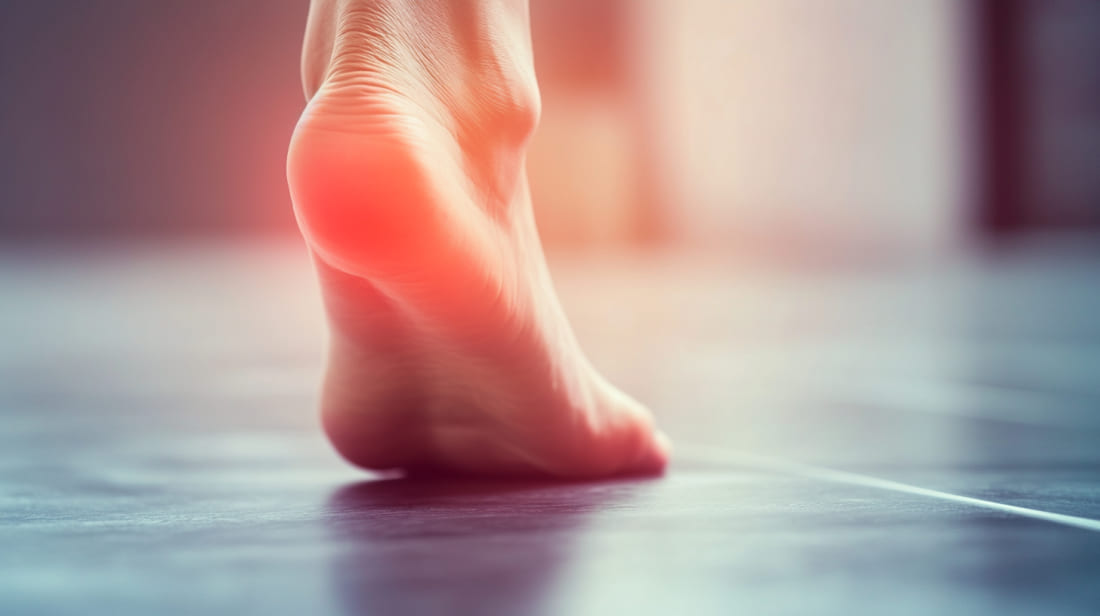
A stone bruise on the heel is a bruise to the fat pad and soft tissue under the heel bone, usually from a hard impact or repeated pressure. A stone bruise tends to feel like a deep, tender spot in the center of the heel, as if you are stepping on a pebble that is not there.
The fat pad is the thick cushion of tissue under your heel bone. It takes the load every time your heel meets the ground. When that padding gets bruised, ordinary walking can start to feel sore.
Common triggers
- Stepping hard on a rock, a curb edge or something left on the floor
- Jumping down onto a hard surface
- Long hours standing or walking on concrete, tile or other hard floors
- Worn-out shoes or thin soles with little cushioning left in the heel
- Going barefoot on hard ground more than your feet are used to
How people describe a heel bruise
People usually describe a deep ache rather than a sharp, stabbing pain. Pressing a thumb into the middle of the heel often finds one tender spot. The soreness tends to show up whenever weight lands on the heel, not mainly in the morning.
A stone bruise on foot is not limited to the heel. The same kind of bruise can happen under the ball of the foot, especially after a hard landing or a long walk in thin shoes. Stone bruises on feet in either spot tend to feel like a bruise from the inside: tender to touch and sore with each step.
If you cannot put weight on the foot, or you notice swelling or discoloration after a fall or jump, get checked by a doctor or podiatrist. Those signs can point to an injury that needs more than rest.
What plantar fasciitis feels like
Plantar fasciitis is irritation of the band of tissue that runs along the bottom of the foot from the heel to the toes. People with plantar fasciitis often feel sharp pain near the front of the heel that is worst with the first steps after sleep or sitting, and the pain usually builds gradually rather than starting from one injury.
That band of tissue is called the plantar fascia. It stretches and tightens as you walk, and it connects to the heel bone near the front of the heel. That is why plantar fasciitis pain tends to sit further forward than a stone bruise.
Where plantar fasciitis hurts
The typical pattern people report is a sharp or stabbing pain near the front and inner side of the heel. Some people also feel it spreading into the arch. Pressing the very center of the heel pad may not hurt as much as pressing just in front of it.
When plantar fasciitis is worst
Timing is the strongest clue. Many people notice plantar fasciitis pain most with their first steps out of bed or after sitting for a while. The pain may ease once they get moving, then return after long periods of standing or at the end of the day. Our guide to causes of heel pain in the morning looks at this pattern in more detail.
How plantar fasciitis starts
Plantar fasciitis often creeps up rather than starting with one clear moment. Many people cannot point to a single step that set it off. Some people find gentle stretching makes their feet feel more comfortable; see calf stretches for plantar fasciitis for simple options. Stop any stretch that causes sharp pain.
Plantar fasciitis pain that keeps getting worse, or does not settle with sensible changes to your shoes and activity, should be looked at by a podiatrist.
Where a heel spur fits in
A heel spur is a small bony growth on the heel bone that is usually found on an X-ray. A heel spur can feel like a pointed pressure under the heel, so it is easy to mix up with a stone bruise, and only an exam and imaging can confirm one.
Heel spurs can show up alongside plantar fasciitis, and a spur does not always cause pain on its own. That is why a spur on an X-ray is only part of the picture. A podiatrist looks at where you hurt, how the pain behaves and what the imaging shows, all together.
If you already know you have a spur, our guide to calcaneal spur treatments covers why shoes are a sensible place to start.
Because you cannot see or feel a heel spur from the outside, lingering heel pain that feels like a sharp point is one more reason to get assessed rather than guess.
How the three heel pain patterns compare
The clearest differences between a stone bruise, plantar fasciitis and a heel spur are where the pain sits and when it is worst. A stone bruise hurts in the center of the heel with direct pressure, while plantar fasciitis tends to hurt at the front of the heel with the first steps after rest.
This table compares where the pain sits, how it started, when it is worst and what tends to aggravate it for each of the three heel problems.
| Clue | Stone bruise | Plantar fasciitis | Heel spur |
|---|---|---|---|
| Where it hurts | Center of the heel pad, under the heel bone | Front and inner side of the heel, sometimes into the arch | Under the heel, often felt as one pointed spot |
| How it started | Often after a hard landing, a step on something hard or long hours on hard floors | Usually builds gradually, often with no single injury | Usually found on an X-ray; may appear alongside plantar fasciitis |
| When it is worst | Whenever weight lands on the heel | First steps in the morning or after sitting, and after long standing | Varies from person to person; can resemble plantar fasciitis |
| What makes it worse | Hard floors, going barefoot, thin or worn shoes, jumping | Long periods on your feet, unsupportive shoes, starting to walk after rest | Pressure under the heel and long periods of standing or walking |
| When pressed | Tender right in the middle of the heel | Tender just in front of the heel, toward the arch | Can feel like a sharp point under the heel |
The takeaway: the timing and location of your heel pain are the most useful clues, but these patterns overlap. Two problems can also happen at the same time, such as a bruised heel pad on top of plantar fasciitis. Use the table to prepare questions for your podiatrist, not as a substitute for an assessment.
Stone bruise relief: careful first steps at home
For mild heel pain, stone bruise relief usually starts with taking pressure off the sore spot: ease off running and jumping, wear cushioned supportive shoes and avoid standing barefoot on hard floors. If the pain is not easing, keeps coming back or gets worse, see a podiatrist.
The usual stone bruise remedy is simple: give the bruised padding a break from impact. These general stone bruise treatment ideas are careful, low-risk steps for mild pain only.
- Rest from high-impact activity. Swap running, jumping and court sports for gentler movement while the heel is sore.
- Use a cold pack wrapped in a cloth. Apply it for short periods, and never put ice straight on the skin.
- Wear cushioned, supportive shoes. Choose shoes with a firm heel and real cushioning, even around the house.
- Avoid going barefoot on hard floors. Tile, wood and concrete put direct pressure on a sore heel.
- Try a soft heel cushion. Extra padding under the heel can make walking more comfortable for some people.
- Replace worn-out shoes. Flattened cushioning offers little protection.
Avoid pushing through heel pain with running or jumping. Impact on a bruised heel pad can keep the soreness going longer.
Home care is for mild pain. If mild heel pain is not easing, keeps coming back or gets worse, see a podiatrist, since lingering pain may have a different cause than a simple bruise.
What Upstep customers ask about heel pain
Many Upstep customers describe heel pain in the same way: it feels like a stone is stuck under the heel, or it stings when they take their shoes off. Our answer is always the same first step: the cause is hard to pin down online, so a podiatrist's assessment comes before any fix.
These are the patterns we see most often in the heel pain questions people send us:
- The heel feels as if there is a rock lodged inside it.
- The pain is under both heels, not just one.
- The pain turns sharp when shoes come off and bare heels touch the floor.
- People want to know which foot problem they have.
That last question is the one we cannot answer over the web. A description can sound like a heel bruise, plantar fasciitis or something else, and only an in-person exam can sort that out. So we point people to a podiatrist first.
Once customers know what they are dealing with, some share how Upstep custom orthotics have worked for their heels. These are individual experiences:
comfortable, less heel issuesBarry
Makes a huge difference in reducing the pain in my heel due to bursitisMark
Mark's heel pain came from bursitis, not a stone bruise or plantar fasciitis. Heel bursitis is irritation of a small fluid-filled sac near the heel bone. His story is a good reminder that heel pain has many possible causes. Everyone's feet are different, and results vary from person to person.
Where Upstep custom orthotics fit
Upstep custom orthotics are not the first step for sudden, severe or unexplained heel pain; get that assessed first. Once you know what is going on, Upstep custom orthotics are designed to cushion and support the heel and may help with comfort, especially if you stand or walk on hard surfaces for long hours.
Each pair of Upstep custom orthotics is built from an impression of your feet, so the support follows your own foot shape. Different designs focus on different needs.
Upstep Heel Pain Custom Orthotics are designed to cushion and support the heel, with extra heel cushioning, shock absorption and pressure relief.
Upstep Plantar Fasciitis Custom Orthotics are designed with targeted heel cushioning, a deep heel cup and arch support.
If long shifts on hard floors are part of the picture, Upstep On My Feet All Day Custom Orthotics are designed for people who stand or walk 4+ hours daily, with maximum arch support for all-day comfort.
How the process works
- You order, and your impression kit ships in 3-5 business days.
- You take your foot impressions and send the completed kit back.
- Your Upstep custom orthotics are made and shipped in 12-18 business days after the completed kit arrives.
Shipping is free, and Upstep custom orthotics are HSA/FSA eligible. You can see current pricing on the product page.
What to expect in the first weeks
Adjusting to Upstep custom orthotics takes time. Some soreness in the arch, ankle or calf in the first weeks is common as your muscles get used to the support. That is why there is a 21-day adjustment period. You also have a 180-day money-back guarantee and one complimentary redesign within the guarantee. If you return shipped orthotics for a refund, a return shipping fee of $19 per pair applies.
If new or sharper pain appears while you adjust, or your heel pain gets worse, check in with a podiatrist. Upstep custom orthotics are designed to support the foot, not to replace an assessment of what is causing your pain.